What water should you use in an espresso machine in Singapore?
Start with fresh cold tap water if your machine allows it. Boiling, filtering and buying distilled water do different jobs.
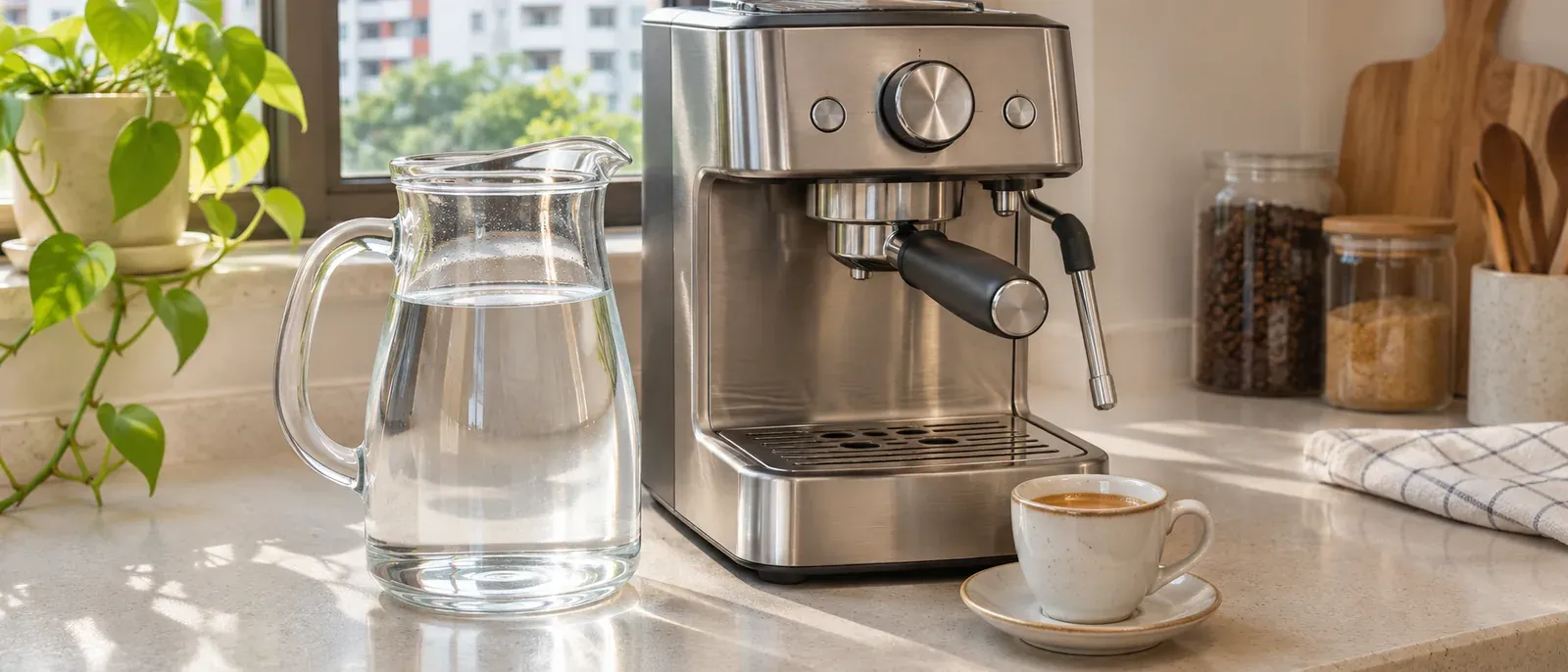
I heard that Singapore tap water should be avoided in an espresso machine. That sent me wondering whether to boil the water or buy distilled water instead. Aiyoh, I only wanted to fill the tank.
In Singapore, start with fresh, cold tap water if your machine’s manual allows it. Filtered tap water can be suitable too, depending on the filter and the machine’s requirements. I wouldn’t buy plain distilled water as the default.
I’ve written about making coffee at home. This is the less glamorous part: working out what goes into the water tank.
Tap, filtered, boiled or distilled?
| Water | What I’d do |
|---|---|
| Fresh cold tap water | Start here when the manual permits it; check any water specifications or hardness setting. |
| Filtered tap water | Check the cartridge. A taste or particle filter doesn’t necessarily soften water. |
| Boiled, cooled water | Don’t boil it just to protect the machine. Boiling removes only some types of hardness. |
| Plain distilled or reverse osmosis (RO) water | Use only if the manufacturer permits it, with any treatment it specifies. Very low mineral content can cause problems in some machines. |
| Alkaline or mineral-added water | Check the finished water against the machine’s requirements before using it. The label alone doesn’t tell you enough. |
Fill the tank at the temperature your manual specifies. Hot water from a dispenser isn’t a shortcut when the instructions call for cold water.
Singapore tap water isn’t automatically too hard
PUB describes Singapore tap water as moderately soft and safe to drink straight from the tap without further filtration.
Its January–December 2025 water-quality report gives an average total hardness of about 43 mg/L as calcium carbonate, with a reported range of about 7–191. Those are results for water produced by the waterworks and desalination plants, not a reading from my kitchen tap.
That makes tap water a sensible starting point to check against your manual. It doesn’t prove that every Singapore tap meets every espresso machine’s requirements.
For a concrete example, the Breville Barista Pro BES878 manual calls for fresh cold tap water and warns against highly filtered, demineralised or distilled water. That’s guidance for that model; use the instructions for yours.
Hardness, scale and corrosion
Hardness mainly measures dissolved calcium and magnesium. When water is heated, some of those minerals can form the hard deposits we call limescale, which can build up inside a machine and affect its operation.
Corrosion is damage to the metal itself. It depends on the water’s chemistry and the materials it touches, including factors such as pH, alkalinity and chloride content. Removing every mineral doesn’t guarantee protection from it.
Alkalinity is another measurement: how well water neutralises acid and resists changes in pH. It isn’t the same as hardness, and a pH number alone doesn’t tell you the alkalinity.
You don’t need to memorise the chemistry. If a manufacturer gives separate limits for hardness and alkalinity, check both.
What about a Hydroflux NAMI?
We have a Hydroflux NAMI at home. The first thing to check is which cartridge is installed, because NAMI has alkaline and non-alkaline options.
The non-alkaline replacement pack lists filters for dirt, organic chemicals, fine particles, bacteria and viruses. That listing doesn’t provide output hardness, alkalinity or pH figures, so I can’t use it to declare our dispenser water suitable for an espresso machine.
In general, carbon filters can improve taste and odour, while particle filters catch particles. A softener reduces hardness; RO removes much of the dissolved mineral content. Some cartridges combine treatments, so check the actual specification.
An alkaline cartridge adds another thing to verify. Don’t assume that water marketed as alkaline is better for coffee, or that the non-alkaline option has no minerals.
NAMI also has a 27°C ambient setting. That’s a temperature option, not proof that its water meets your machine’s requirements.
Boiling and distilled water aren’t universal fixes
According to the Drinking Water Inspectorate’s hardness guide, boiling can remove temporary hardness by forming scale. Permanent hardness remains, so boiled water isn’t the same as distilled water.
Plain distilled water has very little mineral content. RO can also remove most minerals, although some systems add minerals back afterwards. The finished water is what matters.
La Marzocco warns about unsuitable low-mineral water, including corrosion concerns and problems with some water sensors. A machine may fail to recognise that water is present even when the tank is full.
That doesn’t mean every low-mineral water corrodes every machine. It means buying the purest-sounding bottle isn’t a reliable way to choose espresso water. If your manufacturer allows remineralised RO or distilled water, follow its requirements for the finished water.
When I’d test the water
If your machine supplies a hardness strip or asks you to set a hardness level, test the water you actually plan to put into it. After a household filter, that means testing the filtered output.
If the maker specifies alkalinity, pH or other limits, check those too. A hardness strip can’t answer all of them. Retest when you change water sources or cartridge types, and ask the manufacturer or service agent about results outside its limits.
Then follow that model’s cleaning, filter replacement and descaling instructions, including whether descaling is a home job or needs servicing. Filtered water doesn’t make maintenance optional.
First job for me: check which NAMI cartridge is installed.